News flash: The Americans with Disabilities Act does not apply to Canada!
It feels as though we shouldn’t need to explain that, but it is one of the things we have to tell people quite often.
After all, Canada is part of North America, and we are North Americans. But the USA-ers call themselves “Americans” so, we need to watch out for stuff like that.
Many people, when looking for service dog access laws, find American websites and think that the information applies to them. It does not!
But have no fear, because Canada also has laws protecting service dog users. Just… different ones.
Disclaimer: We are service dog trainers. Not lawyers. For a more nuanced view of your own personal situation, please contact a disability law expert, and don’t rely on someone who gets drooled on by dogs for a living.
Service Dogs Are Disability Equipment
Disabled people are protected by several important laws. Under both the Charter of Rights and Freedoms, as well as the Human Rights Act, and the Accessible Canada Act, it is against the law for a service provider to turn someone away or deny them entry because of their disability.
This means that they can’t say that your oxygen tank is too bulky, or that your wheelchair might knock over their china displays.
Service dogs are not specifically mentioned, but they are considered disability equipment. Denying your service dog is like denying your wheelchair or your oxygen tank.
So if you identify yourself as a person with a disability and inform them that this dog is your medical equipment, they are supposed to let you walk in. You shouldn’t need to prove that you need the dog, anymore than you need to prove that you need your wheelchair.
Keep in mind, though, that they are still free to kick you out for being a pain in the neck.
Businesses have rights too, and that includes the right to kick out people who disrupt business or create hazards for their other customers.
Therefore, they can’t deny you entry because you have a service dog.
But they can kick you out if your dog isn’t behaving properly.
You must always remain calm and polite and keep your dog out of people’s way as much as possible. A well trained service dog knows to keep out of people’s way. The ultimate compliment we can hear is “oh, I had no idea there was a dog here!”
Many people who take businesses to the human rights tribunal over service dog denial lose their case because the business can prove with video or multiple witnesses that the person and their “service dog” were being disruptive.
…And that is assuming they were even able to prove that their dog was medical equipment in the first place.
Understanding Undue Hardship
Another limitation to disability rights is the concept of “undue hardship”. That basically means “within reasonable limits.”
It means that they can still deny you if they have a really really good reason.
Example 1: Vancouver Aquarium’s tropical area.
The Vancouver Aquarium has a lovely area habitat for some of their tropical animals including a couple of sloths, many birds, butterflies, turtles etc. You can walk right through it along a little path and look for the sloth hiding in the tree branches above you.
Service dogs are not welcome in there. It is a habitat for their animals, and they have the right to say that you cannot bring your dog into a habitat with free moving insects, birds, reptiles and mammals.
It is undue hardship to ask them to put their animals at risk.
So you can ask someone to wait with your dog outside and go in yourself – the path is wide enough for wheelchairs – but your dog must wait outside.
Example 2: An MRI Machine
MRIs use extremely powerful electromagnets. No metal can be brought into the room that houses the MRI unit. The only way your dog could come in would be if all metal was removed from your dog, which means basically your dog being uncollared and unleashed and loose in a room while you are inside the machine and being ordered not to move or talk.
Completely reasonable that they ask that the dog wait outside.
Example 3: A hospital burns ward.
People with severe burns are at high risk of infection. It is completely reasonable for the nurses to ask you not to bring your dog into this unit, where they work so hard to keep germs and dirt out.
Example 4: A rollercoaster ride
If you take your service dog to Disney, you will find that your dog is banned from most rides. This is for the safety of everyone involved. It would definitely be undue hardship (on the animal too!) to expect them to come up with a special doggy buckle that keeps them safe.
Instead, they have crates waiting at the exit area where your dog can wait for you while you ride.
What About Allergies?
One of the most common excuses for banning service dogs is “some of our clientele may be allergic to dogs”.
At first glance, this seems fair.
People with allergies (many of whom have service dogs to alert them to the presence of deadly allergens) have a right to access the world too. They also deserve accessible spaces where they aren’t at risk of death.
That being said, a life-threatening reaction to a brief exposure to dog dander is not common.
Most deaths caused by anaphylaxis are triggered by foods, medications, or insect/venomous animal bites.
People with asthma can have asthma attacks caused by dog dander, however, and these asthma attacks can sometimes be serious.
Therefore, if the space you are trying to enter is a special “clean” space reserved for people with severe reactions to allergens, such as a dedicated room at the doctor’s office, or an asthma clinic, they have a legitimate reason to deny you.
But if they sell peanuts or shellfish, which are far more likely to be deadly… Then this isn’t really about allergies.
You can do your part by keeping your dog clean and well-groomed, using a bib or bandana to catch and wipe away any drool, and keeping your dog off of furniture especially anything with upholstery in public spaces.
If a person identifies themselves to you as someone with a severe dog allergy (or even just a phobia of dogs), then it is on you, as a fellow person with a medical issue, to help accommodate their needs by keeping your dog away from them or asking to be seated further away, or simply being understanding when they decide to ask to be reseated elsewhere.
We must accommodate each other to create an accessible world.
Traveling With A Service Dog
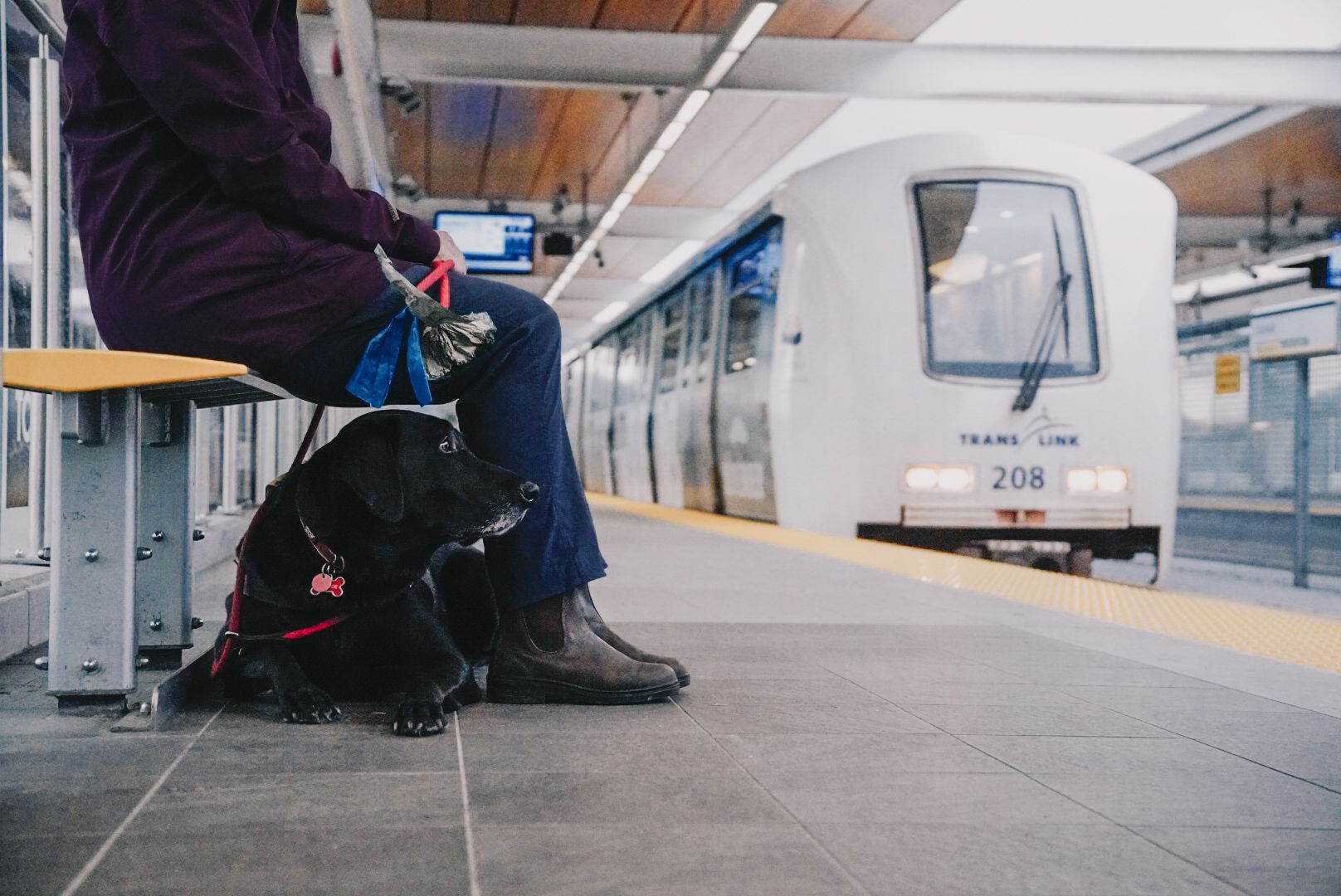
One of the few federal laws that specifically mention service dogs is the Canadian Transportation Agency’s Accessible Transportation for Persons with Disabilities Regulations.
These regulations specifically define service dogs as trained dogs whose tasks with the person’s disability and was trained by a professional service dog institution.
It does not specify that the institution has to be accredited by Assistance Dogs International or the International Guide Dog Federation, but they do say they have to be a training school which specializes in service dogs. It cannot be your Pet Smart puppy school.
They also say that the transportation carrier has the right to ask for proof of the dog’s training and service dog status when you book and on the day you travel.
The big hole in this is the lack of mention of provincial certifications. The (probably Ontarian) writers of this law didn’t seem to know that many Canadian provinces have certification laws for service dogs.
They SHOULD have written that provincial certification counts as proof that the dog is a task-trained service dog. But they did not.
Some carriers recognize provincial certification as proof, but some do not. Do not rely on your certification card only! Bring as much documentation as you can when you book and on the day that you travel.
No, They Cannot Charge You For An Extra Seat
You are welcome to choose to purchase a second seat to make a more comfortable space for yourself and your dog, but Canadian carriers cannot require it.
The CTA has very specific guidelines about how much room they MUST reserve for your dog based on the dog’s size.
It is on you, however, to remind them of this and tell them how big your service dog is when you book your ticket including length and height. If you are booking at short notice, they may legitimately not have room for your dog.
The Real World Doesn’t Know The Laws
Now that you understand Canada’s laws regarding disability access rights and how they apply to service dogs, you must be prepared to see them being broken on a nearly-daily basis.
The fact is that they do not teach this in school. The people greeting you at Walmart or at your favourite restaurant are not educated in disability law and how it applies to service animals… especially because each province has their own service dog laws.
Some of the people who stop you may be malicious anti-dog ableist jerks. But most of them are simply trying to keep their job and avoid getting yelled at by their boss.
So don’t be afraid to ask for management, and just calmly explain the laws and how they apply. Don’t be disruptive, and do ensure your dog is behaving impeccably. You can even show them how well trained your dog is by showing off a heel or a stay.
You may still be turned away, and there is not much you can do about that, unfortunately.
You can go to the Human Rights Tribunal… but a court case will take months to years and you may not even win if the business can justify kicking you out.
If the business is a federally regulated entity like a bank or an airline, you can go to their governing body, but you may never hear back about it.
There is a huge gap between how things should be and how things actually are. All we can do is keep educating, hold onto our empathy, and be prepared to document and report violations.
Post Author:
heelingassistants
Categories:
Date Posted:
June 9, 2026






 LGBTQIA2S+ Safe