your ptsd dog should not be bothered by your ptsd

It seems very odd that we need to spell this out to people. You might be amazed to hear how often we hear from people who have been sold a “PTSD dog” or “Anxiety Support Dog” by a supposed service dog school and then when the dog acted anxious or aggressive, the school blamed the person’s disability.
Like… what?
You wouldn’t hand a guide dog to a blind person and blame them for not seeing better when the dog bumps into things, would you?
You wouldn’t hand an arthritic dog to someone with osteoporosis and tell them they need to carry the dog up and down stairs, right?
Then why – oh why – are do we keep seeing cases of trainers who have handed – nay, SOLD – a dog that cannot work with an anxious or insecure handler to someone who is anxious and/or insecure?
Dogs Who Need Emotional Support Need Not Apply
It is well known among dog trainers that dogs tend to mirror their handlers’ behaviour and emotions. Deeply empathetic creatures, dogs tend to feel what we feel. Their behaviour can change based on who is handling them. Dogs who are relaxed with a confident person can be restless and edgy when paired with someone who is stressed out.
There is a reason why accredited schools generally breed their own dogs instead of using rescue dogs – most rescue dogs carry their own traumas. They need to be healed and supported themselves and are not fit to be the bearer of a human’s burdens.
So what if the handler has PTSD? Or Generalized Anxiety? Or Autism? What if they feel… terrible?
Well, that’s the problem. Sometimes a traumatized or highly stressed handler leads to a traumatized and highly stressed dog.
The average normal dog can’t be a therapy dog or a PTSD dog or an autism dog. It’s too stressful, too draining to be constantly soothing someone else, especially when you yourself could use some reassurance.
When a legitimate service dog school places a dog with someone who has disabling anxiety, trauma, and other psychiatric struggles, they choose a dog who doesn’t feed off of their handler’s energy that way.
These dogs do exist – there are dogs who are so confident that they are not anxious even when their owner is. There are dogs who feel so safe and secure themselves that they have plenty of reassurance leftover to give to others.
There are dogs so happy, that no amount of depression can bring them down.
Choosing an appropriate dog for the job is vital for the mental health of both the dog and their handler.
The Risks of an Unsuitable Dog
Amplifying Each Other’s Anxieties:
Many dogs are stressed by crowds and noises, so they turn to their handler for emotional support. But if their handler also hates crowds and loud noises, then the dog can actually become an added stressor in those situations or an excuse to avoid those situations: “My dog couldn’t handle that and I couldn’t handle it without my dog”.
…Except the whole point of a psychiatric service dog is to make situations like this more accessible for you, not less!
The Aanderson Guidelines for Prescribing A PTSD Dog specify that if the dog could be used as a reason to avoid medical appointments or social events, then the dog will do more harm than good.
Masking Feelings:
Either the dog, or the handler, or both, can learn to hide their feelings from the other. Dogs who are not cut out to be in public spaces but are forced to go anyway learn to shut off their emotional side and just act like they are okay.
Guess what – people with generalized anxiety or a history of trauma do that too!
So now you have a person hiding their anxiety from their dog and maybe the dog hiding their anxiety from the person… a survival strategy which is known to worsen mental health over time and result in burnout for dog, handler, or both.
In each of the above cases, the service dog is actually worsening the person’s situation, not helping it.
A sensitive dog paired with the wrong handler can create a perfect storm that makes life harder for everyone involved.
The Right Dog Is A Ray of Sunshine
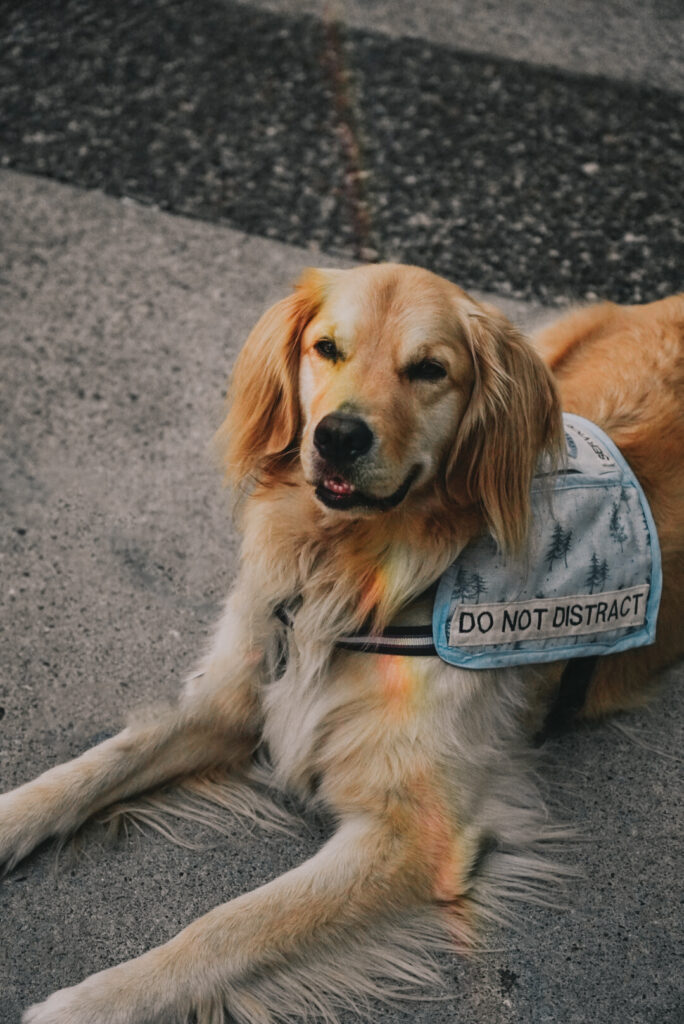
If you are hoping to find and train your own PTSD dog/GAD dog/autism dog etc, your first and most important mission is to find that unicorn of a dog who is happy and confident regardless of how their human is feeling.
You need a dog so easy-going that they can shake off your panic attacks without trouble. You want a dog who is so relaxed and trusting that they would doze off in your lap in the middle of the zombie apocalypse.
The dog must be strong in the areas where you are weak – if you hate sounds, they should barely notice sounds. If you hate crowds, they should thrive in crowds. If you can’t settle down, the dog should start snoring as soon as your butt touches a chair. Your dog’s energy should counteract yours, so that you balance each other.
For example, my own autism dog’s evident delight at being in a busy, crowded mall at Christmas time makes the shopping trip more tolerable and even… dare I say it… fun? She is just so freaking happy to be crushed on all sides by last-minute-shoppers that I can’t help but feed off of her energy. This is her idea of a party, and her shining eyes bring a smile to my face. Her delight is so contagious it makes everyone around us smile. It’s too funny to watch her collapse on her back and demand belly scratches from about six people in line around us, while they laugh and coo over her, their last-minute-shopping stress momentarily forgotten.
Another one of our dogs is so tuned in to his owner, and yet so confident in himself, that he sees her struggles as problems to be solved. He lounges under a chair as trained… until the chiropractor touches the wrong spot on his handler, and he sits up. The chiropractor takes the cue and says “does that hurt?”, and when she confirms that it does, they change what they are doing and the dog lays back down again, relaxed again.
He isn’t stressed or bothered by any of this. He feels he has this situation well under control, which he does!
That is what you are looking for, my friend.
At the end of the day, a psychiatric service dog should be a partner who balances you and brings joy, comfort, and confidence into your life.
If a service dog school has placed a dog with you and is blaming your disability for the dog’s misbehavior… that is not your fault. It is theirs.
Post Author:
heelingassistants
Categories:
Date Posted:
December 7, 2025



 LGBTQIA2S+ Safe